Rindy Anderson, Ph.D
Associate Professor
Charles E. Schmidt College of Science
Biological Sciences
Boca Raton Campus | Davie - DW, 336 | Boca Raton - SC, 207

Education
- Ph.D. in Biology, University of Miami, 2006
Research Interests
- Animal behavior, behavioral ecology
- Communication, bioacoustics
- Cognition
- Avian ecology and conservation
Research Description
Dr. Anderson studies animal behavior with a focus on social behavior, communication, and cognition.
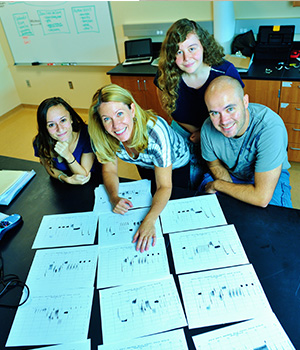
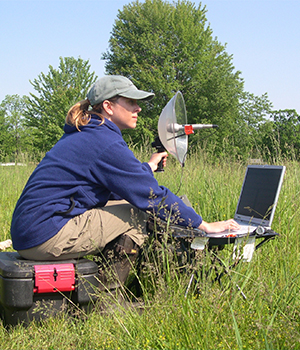
Through the Behavioral Ecology and Bioacoustics Laboratory, Anderson and team employ field behavioral ecology and laboratory experiments to study the form and function of communication signals, mechanisms that enforce reliability in signaling systems, and the role that cognitive abilities such as learning and memory play in sexual signaling and mate choice. The Laboratory focus is to study the vocal behaviors of songbirds as a model system to understand how behavior develops and evolves.
Anderson’s approach is interdisciplinary and collaborative, combining acoustic recording and analysis, tests of cognitive performance, field observation and experimentation of wild birds, studies of behavioral development in captive birds, and hormone measurement and manipulation.
Currently, Anderson and team are expanding the research scope to include proximate mechanisms of behavioral regulation, including microbiome analysis, and endocrinological mediators of aggression and stress responsiveness, to understand the evolution of social behavior and communication systems.
Recent Publications
- Heather Wolverton and Rindy Anderson (2024). Syntax in animal communication: its study in songbirds and other taxa. Journal of Avian Biology.
- Charles Daria, Morgan Slevin, and Rindy Anderson (2022). Effects of anthropogenic noise on cognition, bill color, and growth in the zebra finch (Taeniopygia guttata). Acta Ethologica. Special Issue: Impact of global change on social interactions: Ecological and fitness implications. https://doi.org/10.1007/s10211-022-00406-0
- Jill Soha, Joseph Niederhauser, and Rindy Anderson (2022). Song repertoires, song type sharing, and sharing of preferred song transitions in male Bachman’s Sparrows (Peucaea aestivalis). Wilson Journal of Ornithology. 134 (3): 495–506. https://doi.org/10.1676/22-00015
- Charles Daria, Morgan Slevin, Rindy Anderson (2022). Effects of anthropogenic noise on cognition, bill color, and growth in the zebra finch (Taeniopygia guttata). Acta Ethologica. Special Issue: Impact of global change on social interactions: Ecological and fitness implications. https://doi.org/10.1007/s10211-022-00406-0
- Morgan Slevin, Jennifer Houtz, David Bradshaw, and Rindy Anderson (2020). Evidence supporting the microbiota-gut-brain axis in a songbird Biology Letters. Published online https://doi.org/10.1098/rsbl.2020.0430.
- Erik Noonburg, Rindy Anderson (2020) Asymmetric competition and floater dynamics: a model Ecology. Published online https://doi.org/10.1002/ecy.3238.
- Sabah Ali, Rindy Anderson (2018) Song and aggressive signaling in Bachman's sparrow. The Auk: Ornithological Advances https://doi.org/10.1642/AUK-17-216.1.
Scholarly Activities