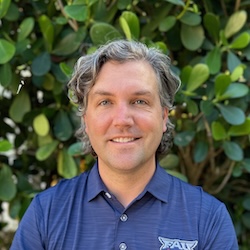
Erik Johanson, Ph.D.
Associate Professor
Charles E. Schmidt College of Science
Geosciences
Boca Raton Campus | SE 473
About:
Ph.D. University of Tennessee, Geography (2016)
M.A. University of Tennessee, Anthropology (2011)
B.A. University of Tennessee, Anthropology (2008)
Environmental Change Lab - website
(@EnvChangeLab)
instagram.com/EnvChangeLab/
facebook.com/EnvChangeLab/
Profile
Dr. Johanson studies environmental change and human-environment interaction across the recent past and into modern times. His interests center around how people shape their environments and manage climate stress in the tropics often by examining environmental proxies in sedimentary archives such as isotopes, pollen, charcoal, diatoms, and microplastics. To develop baselines for ecological management or predict likely future environmental conditions, many of his studies look to the past to inform the present. Research topics include reconstructing fire histories and the historical ecology of the tropics, identifying the timing and pathways for the dissemination of key agricultural domesticates, examining strategies of resilience and societal response to mega droughts and environmental change over time, identifying the environmental impacts of microplastics, the development of paleoclimate records, and the impact and modeling of future environmental change. Dr. Johanson's Environmental Change Laboratory often collects and analyzes sediment cores from lakes and wetlands in Central and South America, the Caribbean, and Florida.
My research program examines the themes of environmental change and human-environment interaction across a range of spatial and temporal scales. Using field-based collection of sediment and water samples along with sediment cores, my group develops high-resolution environmental records through laboratory analyses of ecological and geochemical proxies. Modern research examines environmental hazards and pollutants in diverse systems, from tropical wetlands and lakes to alpine lakes and boreal peatlands, with a particular focus on microplastics, pollen, charcoal, isotopes, and elemental composition of sediments. These data are used to establish ecological baselines that support environmental management and improve predictions of future environmental change. A central component of my work focuses on using sedimentary archives to reconstruct past environments and inform present-day conditions based on a long-term perspective. Research topics include modern environmental hazards, historical ecology including fire and vegetation histories in the tropics, paleoclimate reconstructions, and analyzing past resilience strategies to climate stress. Research projects are often in collaboration with graduate and undergraduate researchers.
Education
Ph.D. University of Tennessee, 2016
Additional
Environmental Change Lab / Johanson Lab website
instagram.com/EnvChangeLab/
Select Publications (* indicates advisee)
- 2025 Garzón-Oechsle*, Andrés E., Erik N. Johanson, Sudhagar Nagarajan and Valentina Martínez. In-Between the Sites: Understanding Late Holocene Manteño Agricultural Contexts in the Chongón-Colonche Mountains of Coastal Ecuador through Remote Sensing and Excavation. Journal of Field Archaeology, 49(2). DOI https://doi.org/10.1080/00934690.2024.2439223.
- 2025 Horn, Sally P., Kurt A. Haberyan, Erik N. Johanson, Mauricio Murillo Herrera, Amanda Tomlinson, Chad S. Lane, Taber Friedel*, and Morgan R. Steckler. A 1500-year Paleolimnological Record from an Ancient Debris Avalanche Landscape in West Central Costa Rica. Journal of Physical Geography .
- 2024 Kathryn Swick*, Erik N. Johanson, and Xavier Comas. A multiproxy analysis of modern environmental change within a cypress swamp forest, Collier County, FL. Discover Environment 2, 39. DOI https://doi.org/10.1007/s44274-024-00065-x.
- 2024Taber Friedel*, Erik N. Johanson, and Sally P. Horn. Post-Conquest Vegetation and Fire Dynamics at Laguna Carse, Costa Rica: A Pollen and Microscopic Charcoal Record. Vegetation History and Archaeobotany, DOI https://doi.org/10.1007/s00334-023-00981-7.
- 2023 Andrés Garzón-Oechsle*, Erik N. Johanson, and Valentina Martinez. The Bola de Oro Manteños and Their Resilience to Climate Change: chronological reconstruction of agricultural modifications through age-depth modelling and carbon abundance analysis. STRATA, Vol. 1 (2), 1–31. Instituto Nacional de Patrimonio Cultural - Ecuador. DOI https://doi.org/10.5281/zenodo.10246526.
- 2023 Madeleine Bitting*, Erik N. Johanson, Kurt Haberyan, and Sally P. Horn. Response of Diatom Communities to Climate and Human Disturbance: A 4200-year record from Costa Rica. The Holocene , 33 (12), 1–13, DOI https://doi.org/10.1177/09596836231197775.
- 2023 Sally P. Horn, Erik N. Johanson, Mauricio Murillo-Herrera, Kurt A. Haberyan, Taber Friedel* and Chad S. Lane. Initial Limnological Observations at Laguna Pozo Verde, Juan Castro Blanco National Park, Costa Rica. UNED Research Journal , Vol. 15(2), 1–6, DOI https://doi.org/10.22458/urj.v15i2.4835.
- 2022 Yanuskiewicz, Elizabeth, Chad S. Lane, Sally P. Horn, Erik N. Johanson, Douglas W. Gamble. Compound-Specific Stable Carbon and Hydrogen Isotope Analyses of Late-Holocene Vegetation and Precipitation Change at Laguna Los Mangos, Costa Rica. Quaternary International , 1–11, DOI https://doi.org/10.1016/j.quaint.2021.08.018.
- 2020 Johanson, Erik N., Sally P. Horn, Chad S. Lane, Maureen Sánchez, Jacob Cecil. Fire History Across the Little Ice Age in Southern Pacific Costa Rica. Journal of Paleolimnology, 1–23, DOI 10.1007/s10933-020-00118-0.
- 2019 Johanson, Erik N., Sally P. Horn, Chad S. Lane. Pre-Columbian agriculture, fire, and Spanish contact: A 4200-year record from Laguna Los Mangos, Costa Rica. The Holocene, 1–15, DOI:10.1177/0959683619862032.
- 2018 Horn, Sally P., Erik N. Johanson, Kurt A. Haberyan, Matthew S. Boehm, Jessie L. Johanson, Maureen Sánchez P., and Mario Hernández V. Initial limnological observations at five small lakes in southern Pacific Costa Rica. UNED Research Journal, Vol. 10(1): 119-134.
Teaching (Undergraduate)
- MET 2010: Weather, Climate, and Climate Change
- EVR 4112: Hazards, Climate, and People(Academic Service Learning component)
- GEO 4915/4916: Directed Independent Research in Geosciences
- GEO 4915: Directed Independent Study
Teaching (Graduate)
- EVR 6931: Paleoenvironmental Reconstruction
- EVR 6417:Paleoenvironments and People
- Pollen in the Neotropics (Directed Independent Study)
- Paleolandscapes in the Neotropics (Directed Independent Study)
- Fire in the Neotropics (Directed Independent Study)
- Past Human-Environment Interaction in Florida (Directed Independent Study)
- Past Climate in the Tropics (Directed Independent Study)
Select Media Coverage
- Climate Change television interview (Channel 10, South Florida),https://www.local10.com/news/local/2021/09/06/florida-continues-to-break-heat-records/
- Hurricane Preparedness article (FAU University Press), https://www.upressonline.com/2021/09/university-professors-discuss-hurricane-preparedness/?return