Coffee Colloquium
The Coffee Colloquium of the Center for Body, Mind, and Culture provides a regular monthly forum for presentations of research work in progress by members of the FAU community. The atmosphere is friendly and informal but also scholarly, and the forum’s goal is to help FAU faculty toward progress in research while building stronger interdisciplinary connections between researchers in different departments. Most of the speakers come from our home College of Arts and Letters, but we sometimes have speakers from other FAU Colleges and special visiting guests from other institutions. The meetings take place during the Fall and Spring teaching semesters. Although the prime focus of the colloquia is to advance FAU research, the colloquia are fully free and open to the public. In accordance with its name, fresh coffee is served at the colloquium events. The Coffee Colloquium is an old Center tradition that began back in 2007 and is still going strong.
Fall 2026
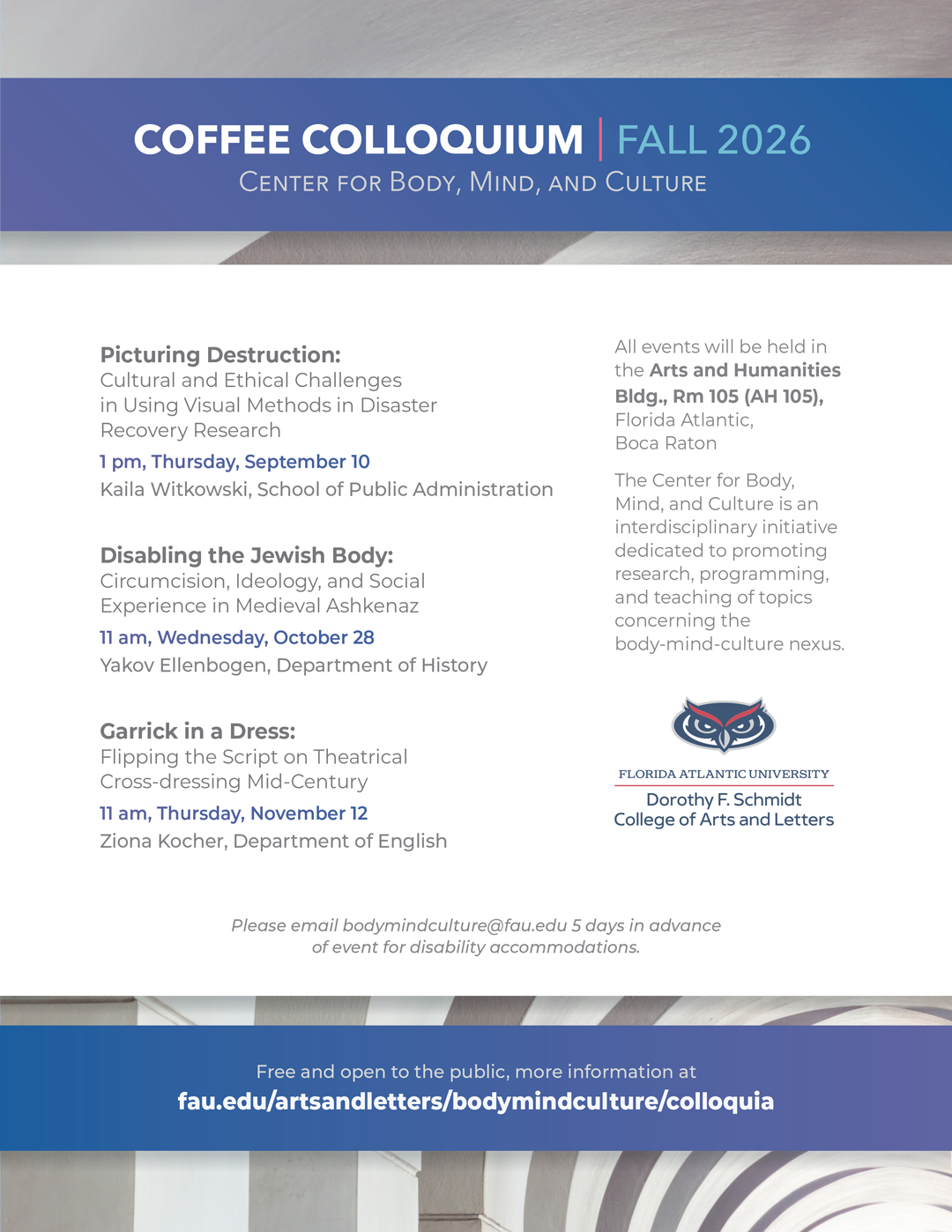
September 10, 2026 AT 1 pm
Kaila Witkowski, School of Public Administration
Picturing Destruction: cultural and ethical challenges in using visual methods in disaster recovery research
Abstract: While photographs have been used in popular culture for decades to capture the devastation of natural hazards, the use of visual methods as a tool to study these disasters is a less common practice. Engaging with literature on visual research methodologies and disaster recovery, this article explores the cultural and ethical challenges of using photo-elicitation to study long-term recovery efforts following the 2023 Maui fires. Drawing on interviews (n=31), researcher-taken photos (n=23), and supplemental data, including social media posts (n=413), we explore the ways we adapted the photo-elicitation method to account for cultural differences between the researchers and participants and how we overcame implementation challenges in the field. The examples presented in this article highlight the importance of reflexivity and flexibility when implementing visual methodologies to study hazards, crises, and disasters.
October 28, 2026 at 11 am
Yakov Ellenbogen, Department of History
Disabling the Jewish Body: Circumcision, Ideology, and Social Experience in Medieval Ashkenaz
November 12, 2026 at 11 am
Ziona Kocher, Department of English
Garrick in a Dress: Flipping the Script on Theatrical Cross-dressing Mid-Century
Abstract: Renowned theater manager, playwright, and actor David Garrick was, in many ways, the defining figure of mid-eighteenth-century drama. Active in the theatrical world from the early 1740s to the mid 1770s, Garrick’s career flourished during the tense period following the passage of the 1737 Licensing Act, which placed significant limitations on the plays performed in London during the period. His focus on adaptations of Shakespeare and bawdy Restoration comedies made him popular in the face of growing cultural conservatism, with tastes turning away from the explicit sexuality that was embraced earlier in the period. For example, his adaptation of William Wycherley’s The Country Wife, titled The Country Girl, removes the play’s cuckolding protagonist, Horner, in favor of recentering the romantic B-plot between Harcourt and Alithea. Despite his turn way from the raunchiness of the late seventeenth- and early eighteenth-century stage, however, Garrick carried one tradition on through his time at Drury Lane: theatrical cross-dressing. While breeches parts for actresses were losing some of their popularity mid-century, such cross-dressing is central to plays like Garrick’s afterpiece The Male Coquette. Garrick himself did not shy away from cross-dressing on stage – a practice that was a rarity during the period. This paper explores how Garrick’s personal embrace of cross-dressing on the stage challenges our understanding of the mid-eighteenth-century stage as a space that rejected the fluidity of gender-sexuality embraced during the early part of the period.
All talks are in collaboration with the Center for Cosmopolitan Culture and will be held in the Arts and Humanaties Bldg., Rm 105 (AH 105). Florida Atlantic University, Boca Raton.