Undergraduate research and inquiry projects are only successful because of the commitment of faculty, who invest their time and talent into mentoring students. Research mentors are dedicated faculty or post-docs who provide undergraduate students an opportunity to engage in research either within the curriculum or through co-curricular mentorship. Engagement of students in research provides valuable opportunities to grow and learn as scholars, and leads to positive outcomes such as academic retention, graduation, and graduate school pathways. There are a variety of ways in which faculty can engage with OURI, as outlined below.
- Funding Opportunities for Faculty
- Recognition Opportunities for Faculty
- Curricular Opportunities
- How to Advertise a Research Opportunity
- Request a Presentation
- Student Presentation and Publications
- Additional Resources
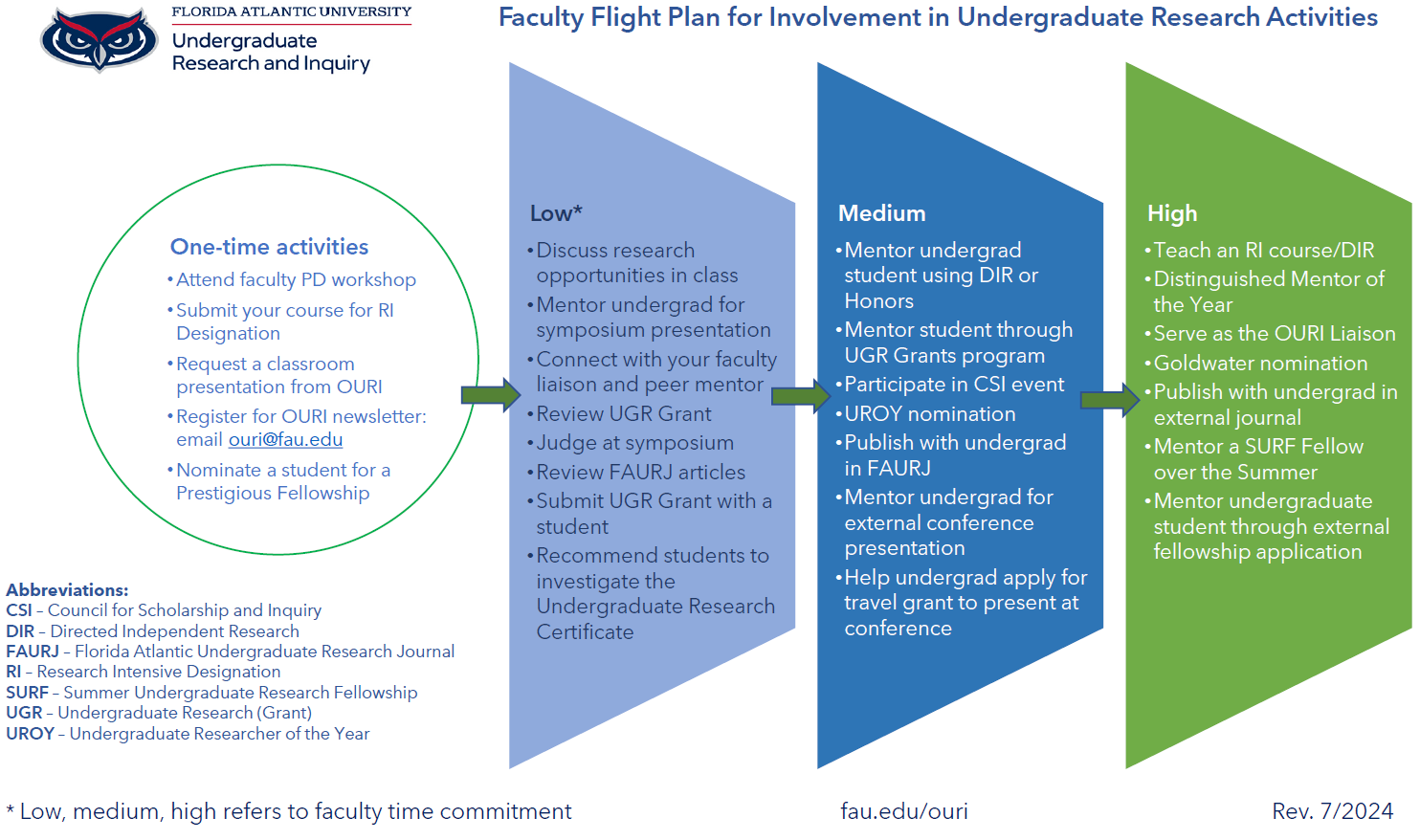
In addition, OURI has developed a flight plan that outlines the time commitment necessary for different levels of involvement.
Funding Opportunities for Faculty through OURI
College Faculty Liaison Program: The OURI College Faculty Liaisons serve as ambassadors for college efforts for the Undergraduate Research and Inquiry (URI) initiative. One faculty member per college will be selected by their College in coordination with OURI to serve in this capacity for 2 years (Fall - Summer). The anticipated time commitment for this appointment is 3-5 hours per week, including monthly meetings, with most of the responsibilities taking place during the fall and spring semesters.
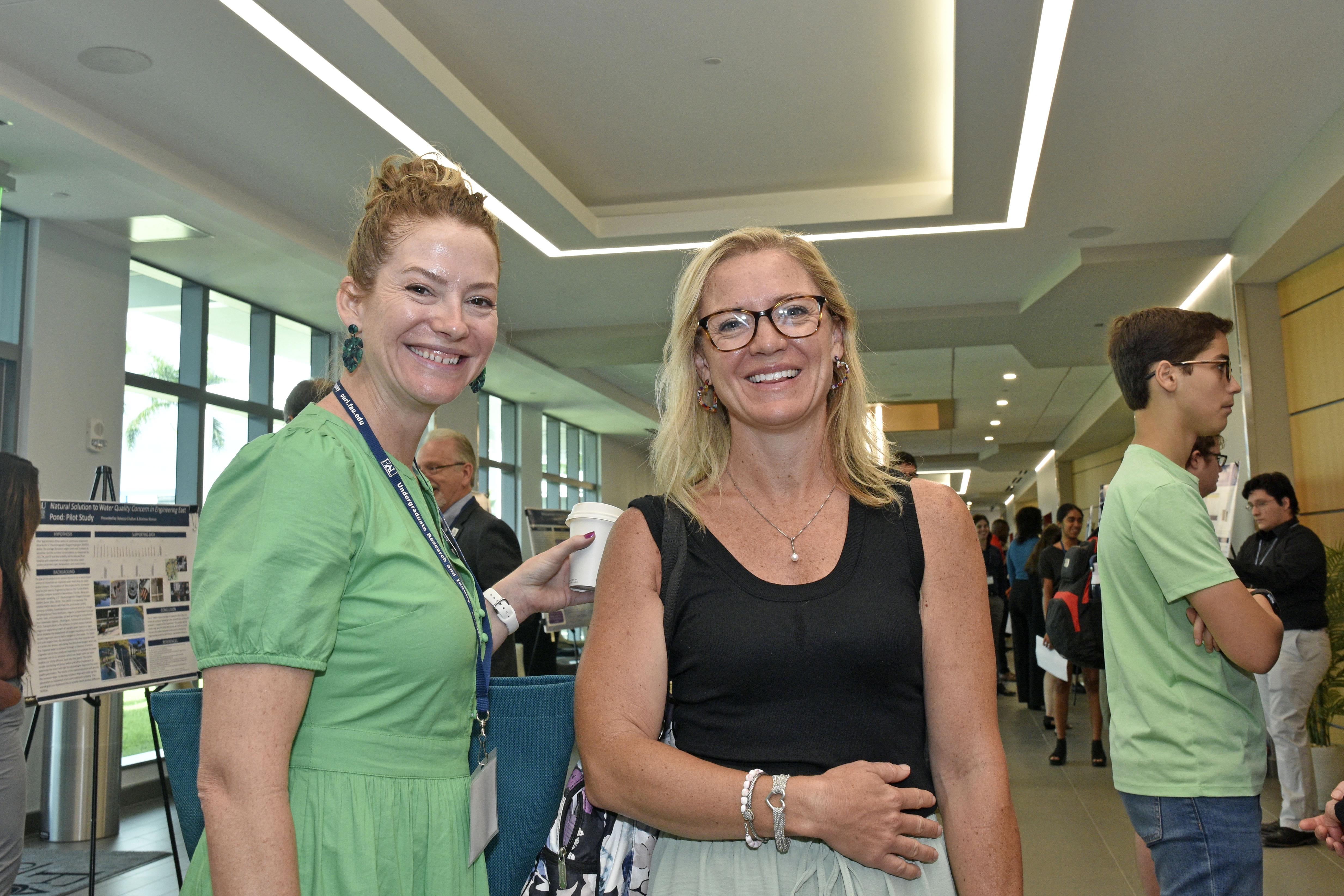
OURI Faculty and College Incentive Fund 24-25: The Office of Undergraduate Research and Inquiry (OURI) is pleased to offer a College and Faculty Incentive Program to faculty for early engagement with students in undergraduate research.
Summer Undergraduate Research Fellowship (SURF): The SURF program is seeking applications from faculty/undergraduate student teams for summer research projects. To submit your project for consideration, faculty must complete the online application providing details about the project and the faculty/student team.
External Funding Opportunites: Principal investigators of current grants may be eligible for supplemental funds to support and include undergraduate students in their funded research projects.
- National Science Foundation (NSF) Research Experience for Undergraduates. The NSF REU program supports research supplements affiliated with existing NSF funded proposals which offer funds to support undergraduate researchers. For additional information please click here: NSF REU Sites and Supplements Solicitation.
- National Endowment for the Humanities
Please see below.
OURI Faculty and College Incentive Fund Programs 24-25
The Office of Undergraduate Research and Inquiry (OURI) is again excited to offer the 24-25 Faculty Incentive Plan, to support faculty who mentor undergraduate researchers within certain priority areas. This incentive is intended to encourage early engagement in undergraduate research of our degree-seeking Freshmen and Sophomore students and our AA Transfer Juniors, and to encourage new FAU faculty to work with these students.
Beginning Summer 2024, incentive funding will be applied within the following categories:
- Mentoring a degree-seeking Freshman, Sophomore or AA transfer Junior signed up through Directed Independent Research (DIR) 4915 and 4916 courses.
- Faculty new to OURI who mentor UGs in research through targeted OURI programs.
- Faculty submitting course syllabi and receiving/teaching Research Intensive (RI) Course designation for lower division and General Education courses
Learn more about OURIs faculty incentive funding.
Questions can be directed to ouri@fau.edu and your College Faculty Liaisons FAU - Faculty Liaisons
Distinguished Mentor of the Year (DMOY) Award
Faculty who serve as model mentors to their undergraduate research students are eligible to receive the Distinguished Mentor of the Year in Undergraduate Research and Inquiry (DMOY) award. Each year, one university-wide award will be given, and the DMOY will be recognized with a $2,500 award at the annual Honors Convocation.
Eligibility
- Any permanent, full-time faculty including tenured/tenure track faculty, non-tenured faculty, instructors, multi-year appointees, scientist/scholars, and research faculty who have been employed for one continuous year.
- Faculty must have engaged as direct mentors of students in undergraduate research and inquiry, to include co-curricular (e.g grants, publications, presentations), curricular (e.g. RI Courses, DIR and DIS), as well as individual and group student mentoring.
- Previous award winners are no longer eligible.
Timeline
- January 12th, 2026 Call for faculty applications/nominations
- February 2nd , 2026 Complete applications due to the Deans/Directors office
- February 16th, 2026 Deans submit College nominee and application materials to OURI
- February 23th, 2026 Faculty Honors and Awards committee begin review
- March 6th , 2026 Honors and Awards Committee selects 2023 Awardee
- April 15th, 2026 Award presented at the Honors Convocation
Contact information for College Submission
Faculty interested in applying for College consideration should send complete DMOY application packages to the following college contacts by the deadline date listed above.
Student interested in nominating faculty should send the name of their nomination to the appropriate college contact below. (Note: Please submit the nomination early enough for the faculty member to assemble their application package.)
Arts and Letters
Mrs. Holly Pereira
pereirah@fau.edu
Business
Ms. Sonia Villanti
svillanti@fau.edu
Education
Mrs. Josephine Elliott
jelliot@fau.edu
Engineering
Dr. Fred Bloetscher
fbloetsc@fau.edu
Honors
Ms. Anna Holmes
holmesa@fau.edu
Medicine
Dr. Mahyar Nouri-Shirazi
mnourish@health.fau.edu
Nursing
Ms. Bernadette Bastien
bastienb@health.fau.edu
Science
Dr. Predrag Cudic
pcudic@fau.edu
Social Work and Criminal Justice
Dr. Ryan Meldrum
meldrumr@fau.edu
Further Information
Complete details and guidelines for the DMOY award can be found here.
2025 Distinguished Mentor of the Year
Harriet L. Wilkes Honors college
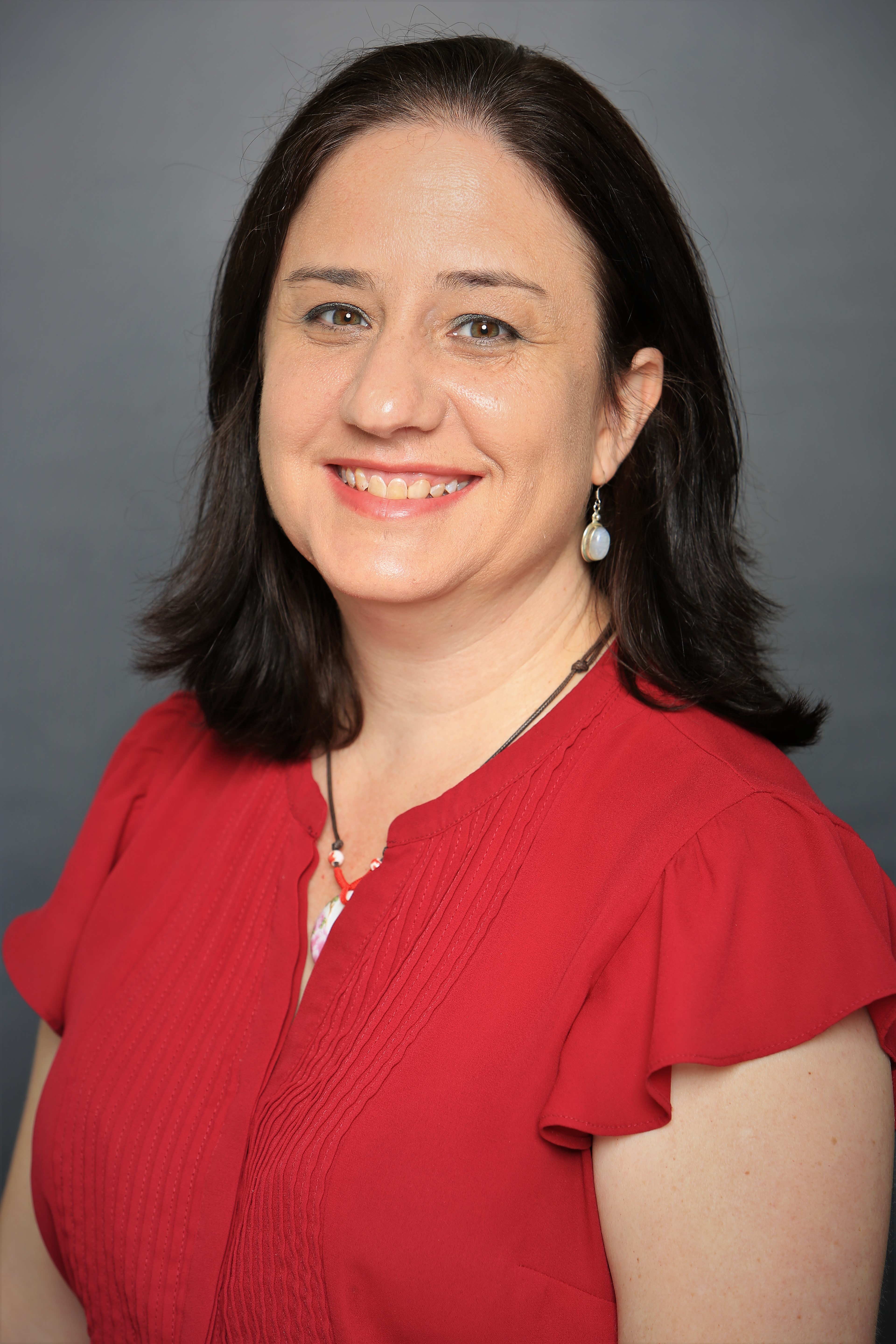
2025 Distinguished Mentor of the Year Finalists
- Justin P. White, Ph.D. Dorothy Schmidt College of Arts and Letters
- Scott Feyereisen, Ph.D. College of Business
- Jimwoo Jang, Ph.D. College of Engineering and Computer Science
- Tiffany Roberts Briggs, Ph.D. Charles E. Schmidt College of Science
- Precious Skinner-Osei, Ph.D. College of Social Work and Criminal Justice
Previous Distinguished Mentor of the Year Winners
| 2024 | Mahyar Nouri-Shirazi, Ph.D. | Charles E. Schmidt College of Medicine |
| 2023 | Mare Cudic, Ph.D. | Charles E. Schmidt College of Science |
| 2022 | Keith Jakee, Ph.D. | Harriet L. Wilkes Honors College |
| 2021 | James H. VanZwieten Jr., Ph.D. | College of Engineering and Computer Science |
| 2020 | Monica Escaleras, Ph.D. | College of Business |
| 2019 | Myeongsub Kim, Ph.D. | College of Engineering and Computer Science |
| 2018 | Julie L. Earles, Ph.D. | Harriet L. Wilkes Honors College |
| 2017 | Tobin Hindle, Ph.D. | Charles E. Schmidt College of Science |
| 2016 | Daniel de Lill, Ph.D. | Charles E. Schmidt College of Science |
| 2015 | Daniel Meeroff, Ph.D. | College of Engineering and Computer Science |
Faculty Resources
Benefits for Faculty Participating in Undergraduate Research and Inquiry
"Undergraduate research is a proven way to build college student success and drive innovation."
- Council on Undergraduate Research
- increases aspirations
- increases core professional competencies
- mentorship and relationships increases students' perception of success
Students are not the only beneficiaries of involvement in undergraduate research and inquiry; benefits to faculty have also been observed. These include enhanced mentoring and teaching, enhanced satisfaction with their career and personal development, achieved scholarly and research outcomes (e.g. presentations and publications), and integrated teaching and scholarship. Faculty who were themselves engaged in similar activities as undergraduates identify the experience as being transformational for their careers.
Articles of Interest:
- Senate Hearing: Driving Innovation through Federal Investments
- It Takes More Than a Major: Employer Priorities for College Learning and Student Success from the American Association of Colleges and Universities
- Engage to Excel: Producing One Million Additional College Graduates with Degrees in Science, Technology, Engineering, and Mathematics from the President’s Council of Advisors on Science and Technology
Working with Minors and non-FAU students
Here you will find a series of resources for faculty who intend to work with minors and non-FAU students interested in working with them on academic or summer research projects.
Internal Resources
- FAU Public affairs has established branding templates to facilitate creating external presentations.
- The FAU Library has established great resources to help in you and your students' research endeavors.
- The Graduate College and the Division of Research have put together a list of workshops for students to attend to improve their understanding of research and how to conduct a project responsibly.
External Resources
Assessment
- Classroom Undergraduate Research Experience (CURE): The CURE survey measures student experiences in “research-like” or other science courses, and may be used as a pretest-posttests or pretest only survey.
Mentorship
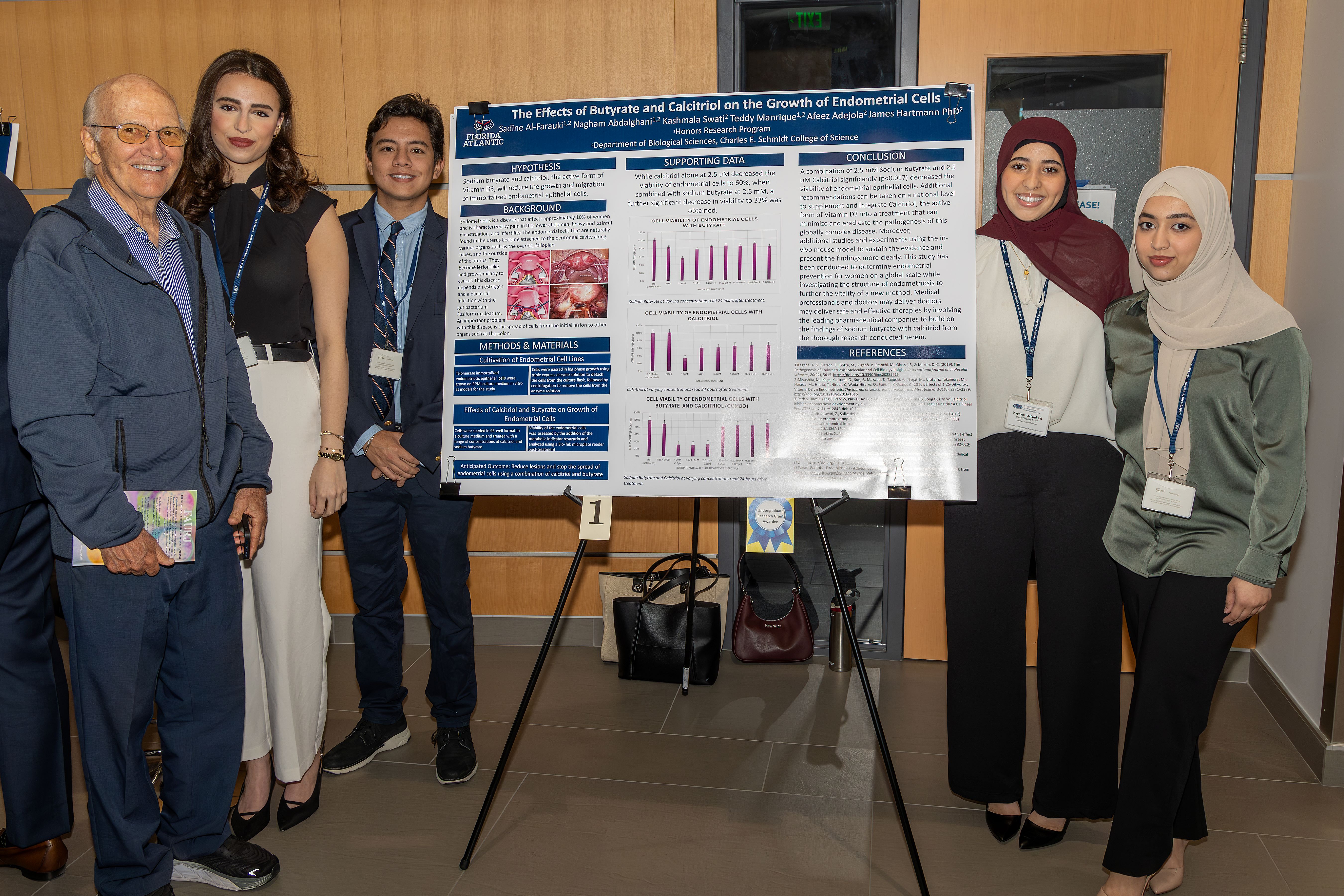
Best Practices
- Have prospective researchers do some preparation for research, such as finding relevant literature, doing a short literature review, or visiting a subject librarian.
- Create clear goals with the student, by week, month, and/or semester.
- Have a check-in system:
- Regularly scheduled meetings afford students the opportunity to report their progress, receive feedback, and seek direction.
- Establishing deadlines keeps students engaged and helps ensure that they progress through the various stages of their research.
- Make yourself available:
- Take time to explain your research and/or academic scholarship to new undergraduate researchers. Talk to them about their future goals and how research can help them reach those goals.
- Foster Community:
- Balance positive reinforcement and (clearly communicated) negative consequences.
- Ideas for creating community include:
- Research team meetings
- One-on-one meetings
- Attending department seminars as a research group
- Journal clubs
- Social outings
- Be Attentive:
- Help them set timelines and deadlines.
- Try multiple lines of communication, when appropriate.
- Encourage Participation in the Broader Research Community
- Refer them to OURI Peer Mentors to learn more about opportunities
- Encourage them to look into local and national conferences
- Notify them about department or campus events
- Tell them about student groups here at FAU
- Be Understanding
- Undergraduates frequently need longer turn-around times than graduate students
- Realize that undergraduate coursework must remain their priority
- Give constructive feedback
- Be clear about how to improve and give them chances to redeem themselves
- Center for the Improvement of Mentored Experiences in Research (CIMER) - Mentor/mentee agreements, mentoring toolkits, and national reports on effective mentorship.
- Five Effective Strategies for Mentoring Undergraduates from the Council on Undergraduate Research
- Perspectives on Undergraduate Research & Mentoring (PURM) is a multidisciplinary journal that includes the processes of undergraduate research and is published by Elon University
- Howard Hughes Medical Institute’s “Entering Mentoring”
- Ten Salient Practices of Undergraduate Research Mentors: A Review of the Literature
- How to Mentor Undergraduate Researchers: A publication of the Council on Undergraduate Research. If any faculty members are interested in obtaining a copy, the OURI office has some for your convenience.
Support for Faculty Teaching Research Intensive Designated Courses
Research Intensive (RI) course designation was developed to increase research opportunities for undergraduates in courses, and to support faculty who are teaching courses designated as Research Intensive. The Office of Undergraduate Research and Inquiry (OURI), provides support to faculty who teach these courses through the following opportunities:
- The Graduate Research Consultant (GRC) program
- Course-Enhancement Expense (CEE) program
Faculty can request support by applying to either one of the above options for each term the RI course is taught. Please note that generally only one application per instructor will be considered each term, subject to funding availability.
Graduate Research Consultant (GRC) Program
Program description
The Graduate Research Consultant (GRC) program provides graduate student personnel to support RI designated courses at FAU.
GRC PROGRAM course eligibility
RI designation must be approved at the State level for a GRC to be offered. Faculty members may be eligible for more than one GRC with appropriate justification, depending on the size of the class and pending availability of funds. An example of the student-to-GRC ratio is as follows:
- Class enrollment is 15 (minimum) - up to 20 = 1 GRC
- Class enrollment is up to 50 = 2 GRCs
- Class enrollment is greater than 50 = 3 GRCs maximum
Faculty expectations
Faculty members will be responsible for:
- Teaching the RI course, including developing, guiding, and evaluating the course assignments
- Selecting their GRC(s) for the eligible RI designated course
- Soliciting and receiving approvals via email from the graduate student’s research advisor prior to the graduate student applying for the GRC program, and
- Mentoring the GRC within the RI designated course
Grc Expectations
GRCs are advanced graduate students (or upper division undergraduates) who are active researchers and scholars in their disciplines.
- GRCs coach and advise the undergraduate researchers in the research and inquiry intensive projects within the course; they are not teaching assistants and do not grade or evaluate student work
- GRCs are expected to work under the guidance of the faculty instructor
- GRCs work closely with the instructor and the students for planning, implementing, and communicating their research and inquiry projects (RI courses are required to include a mechanism for students to communicate their findings publicly; for example, a class presentation, a poster session, a website, etc.)
GRC Eligibility
Candidates should be eligible to work as a Student Worker at FAU.
- GRCs are expected to work 30-40 hours over the course of the semester and are paid $750 for their efforts
- F-1 visa students who are already working 20 hours on campus do not qualify for these positions
Hiring Process
OURI will transfer funds to the Department, who will be responsible for the hiring of the students.
- Graduate students working over 20 hours will need to complete the Graduate College's Form 10
- Undergraduate students who are already working 20 hours for FAU will need approval from their advisor to work additional hours
- New employees, either graduate or undergraduate, will have to go through the hiring process, which includes a background check
- Please notify OURI prior to the funds being transferred so that we can include the cost of the background check
Course-Enhancement Expense (CEE) program
Cee Program Process
Faculty members may request funding to cover materials and expenses necessary to implement their RI course enhancements. Eligible expenses may include travel required to conduct RI project activities, expendable materials and supplies, and one-time equipment purchases. Each course may receive up to $750.00 for every 15 students* enrolled, if funding is available. Faculty must complete a brief justification and attach an itemized budget spreadsheet (link) within the application system.
*Courses with fewer than 15 students may also request CEE funds at a prorated amount. These requests must include the completed budget justification and attach an itemized budget spreadsheet (link) within the application system. Make sure to explain why this course should receive funding even though the enrollment is less than the eligible amount.
Course-Enhancement Expense Program Application
Application Information for both the GRC and the CEE Programs
Deadlines
- Fall RI courses: July 1
- Spring RI courses: December 1, 2025 (for Spring 2026 only)
- Summer RI courses: April 1
(If these dates fall on a weekend or holiday, the deadline will be the next business day)
Requirements
To apply for either the GRC or CEE programs, please complete the online application through Survey Monkey Apply (instructions). The RI designated syllabus and assignment/project(s) for which the GRC or CEE will assist must be submitted or uploaded as part of the application process.
Survey Monkey Apply Online Application Link
Review Process
Both GRC and Course-Enhancement expense applications will be reviewed by the OURI Faculty Liaisons for approval, during the monthly Liaison meetings. Consideration will be given to faculty submitting both individual and group research project proposals.
FAU’s Graduate Research Consultant Program is an adaptation of a program developed by the University of North Carolina at Chapel Hill: https://our.unc.edu/grc/
Working with minors and non-FAU students
OURI has put together some helpful resources for faculty interested in working with students who may still be under the age of 18. We recommend all faculty start by reviewing FAU’s Children in the Workplace Policy and FAU's Volunteer Policy. Faculty and the students conducting research should also review the FAU EH&S Policy on Minors in Research Laboratories or Animal Facilities. See the Office of Leadership Education and Development's Volunteer Policies page for more information about recruiting volunteers.
Faculty members must adhere to the following:
- All faculty working with minors will need to initiate the Environmental Health and Safety Minors in the Lab Proposal outlined below
- Faculty must complete the Child Labor Law Certification form and the Minor Certification form and send both of these to EMPL@fau.edu
- Faculty also need to complete their own background check with Human Resources prior to initiating the Environmental Health and Safety Minors in the Lab Proposal to work with non-FAUHS minors. Note: For FAUHS students, faculty do not need to complete their own background checks with Human Resources prior to initiating the Environmental Health and Safety Minors in the Lab Proposal.
To determine which students are considered volunteers and which forms must be completed prior to having a student under the age of 18, please consider the following:
- Is the student receiving course credit or financial compensation for their work?
- YES:
- These students are not considered volunteers and do not need to complete the FAU Volunteer Registration form
- Students (and mentors) will need to initiate the Environmental Health and Safety Minors in the Lab Proposal outlined below
- NO:
- Students are considered volunteers and will need to be categorized either as a category 1 volunteer or a category 2 volunteer as specified here. The volunteer and their parent/guardian must complete the Parent/Legal Guardian Consent for Criminal Background Check form and send it to EMPL@fau.edu. There is a fee of approximately $20-65 associated with the completion of the background check. Below you will find the forms needed for each category of volunteer.
- YES:
- Category 1 volunteer students and their parent/guardian will need to complete:
- The FAU Volunteer Registration form
- The volunteer waiver and release form
- The Parental/Guardian Authorization for Treatment of Minors Form
- The background check parental consent form
Forms should be submitted to EMPL@fau.edu. There is an approximately $20-$65 fee associated with the completion of the background check. These forms should be submitted to leadandserve@fau.edu. The department that the student is researching with should maintain a copy of the Authorization for Treatment of Minors form as well.
- Category 2 volunteer students and their parent/guardian must complete the volunteer waiver and release form and the Parental/Guardian Authorization for Treatment of Minors Form and submit to leadandserve@fau.edu
Environmental Health and Safety Minors in the Lab Proposal
Faculty must:
- At least 2 weeks before the start date of the research project, a Minors in the Lab Proposal must be submitted to EH&S for approval. Ensure that the student and their guardian(s) complete the Parental Informed Consent and Permission Submit the documents to ehs@fau.edu.
- If the student will be working with animals, review the IACUC Policy and Procedure for Children in Animal Facilities
- Have the student complete the appropriate workplace trainings as necessary and advised by EH&S