Prospective Researchers
Current Researchers
Faculty and Administrators
About
OURI offers support to faculty who are interested in integrating research into the curriculum and developing Course-based Undergraduate Research opportunities (CUREs) for students. The two primary programs to facilitate this include:
Research Intensive (RI) Course Designation: RI designated courses are ones in which undergraduate students actively engage in the process of research and inquiry at the intensive level through projects and assignments. These projects should count for a significant portion of the course grade.
Directed Independent Research (DIR) Course Designation: Directed Independent Research (DIR) courses serve as an alternative/addition to the existing DIS (Directed Independent Study) for undergraduate research documentation on student transcripts. Departments may also include a zero-credit option for DIR students, which would have no additional tuition charge.
UG Research Certificate: FAU now offers an Undergraduate Research Certificate, to recognize undergraduate students for systematic development of excellence in undergraduate research.
Directed Independent Research (DIR) Designation
Directed Independent Research (DIR) courses serve as an alternative/addition to the existing DIS (Directed Independent Study) for undergraduate research documentation on student transcripts. Departments may also include a zero-credit option for DIR students, which would have no additional tuition charge.
DIR New Course Procedures
The Directed Independent Research (DIR) numbering system is being proposed specifically for students engaged in research and inquiry mentored by a faculty member as defined by the Departments and Colleges. These courses can have a variable credit option including a zero credit option (S/U grade only). The DIR specific course numbering system includes the following (course prefixes to be determined by the departments):
- XXX2915 (lower division for grade)
- XXX2916 (lower division for S/U)
- XXX4915 (upper division for grade)
- XXX4916 (upper division for S/U)
Please note all zero-credit offerings for DIR must be for S/U grade.
Departments interested in establishing DIR courses must complete a New Course Form for each new course being proposed, using the DIR course numbering system provided above. No syllabus is required for DIR courses.
Once the new course forms are approved at the Department and College level, faculty can work with the OURI Liaisons and submit the new course form directly to the University Undergraduate Programs Committee (UUPC).
For colleges interested in establishing DIR for several departments within a program, Chairs can work with your College's OURI Liaison to complete a comprehensive proposal to be submitted on behalf of the College.
RI and DIR Courses Approved List by College
Infusing Undergraduate Research into the Curriculum
Undergraduate research plays a critical role in a student’s academic success, learning, and development, including increased retention and higher graduation ratings (Baron et al., 2020).
- High-Impact Practices (HIPs) such as undergraduate research are educational practices that research has shown to increase rates of student retention, student engagement, and persistence to graduation for all students (AAC&U, 2023).
- The benefits of participation in undergraduate research in terms of retention, graduation, deep learning, and self-efficacy, has been substantiated as well (Chamely-Wiik et al., 2023; Bhattacharyya et al., 2018; Chan et al., 2018; Mandernach, 2015; Sweat et al. 2013).
- Students who are involved in undergraduate research are two times more likely to enroll in graduate schools than students who are not involved in research activities while in the undergraduate nursing program (Collins et al., 2017).
Embedding authentic research experiences in courses can help more students gain access to these benefits compared to the single faculty mentor/mentee paradigm. Undergraduate research is typically implemented in various formats to include curricular and co-curricular activities. However, course-embedded research has the potential to broaden undergraduate research participation and early engagement in research in all disciplines (Prajukti et.al., 2020).
Ways to Infuse Undergraduate Research into Coursework
There are several different ways to integrate research into the curriculum. You can see discipline-specific examples below as well as information on how to create a “CURE course."
Specific Discipline Examples
Learn more about how some faculty have infused undergraduate research into courses in their disciplines’ coursework.
Applied Science
Arts and Humanities
- Languages, Linguistics, and Comparative Literature: Introduction to Latin American Studies
- Philosophy: Biomedical Ethics
Health Sciences
Natural Sciences
- Biology: Biological Sciences (Large Lecture)
- Biology: Microbiology (Large Lecture-RI Subsection)
- Mathematics: Calculus (Large Lecture)
Social Science
- Criminal Justice: Drug Court
- Education: Special Education
- Psychology: Evolutionary Psychology
- Public Health, Health Promotion, and Behavioral Sciences
Designing CURE Courses
Course-Based Undergraduate Research Experiences (CURE) are structured courses where students work together in a classroom setting to engage in addressing a research question or problem that is of interest to the research community (Auchincloss et al. 2014). CURE courses can improve the accessibility of undergraduate research experiences by incorporating research into the design of curriculum. CURE courses are characterized by five core principles that distinguish it from other laboratory and research learning experiences:
- The use of multiple scientific and evidence-based practices to generate new knowledge and understanding.
- Research outcomes are not predetermined, positioning both students and instructor as co-participants in the process of inquiry and discovery.
- Focuses on broadly relevant or important work that has meaning beyond the individual course and topic.
- Emphasizes collaboration of groups of students and instructor to tackle a problem.
- Students engage in iterative processes of investigation and revision, building on their own and others' work to strengthen evidence through repeated testing.
CURE courses are not inherently qualified to be designated Research Intense (RI) courses, though they can become RI courses. Some CURE courses may qualify to be designated as an RI course if they engage students in assignments/projects that align with the in the following research Student Learning Outcomes (SLOs). Faculty may seek RI designation for CUREs courses, which may provide support for faculty teaching these courses and allow students to count them in pursuit of the Research Certificate. For more information on Research Intensive course designations, click here.
Interested in finding out more?
We have curated additional resources in a comprehensive CUREs Canvas course to support faculty in integrating research into the curriculum. If you are interested in gaining access to the Canvas course with these materials, please email ouri@fau.edu requesting access to the CUREs canvas course or contact the faculty liaison in your college.
Additional Resources
- CUREnet: a searchable site for already developed CUREs nationwide
- Assessment of Course-Based Undergraduate Research Experiences: A Meeting Report
- The Boyer Report: Reinventing Undergraduate Education: A Blueprint for America’s Research Universities
- Developing and Sustaining a Research-Supportive Curriculum: A Compendium of Successful Practices from the Council on Undergraduate Research
Research Intensive (RI) Designation
What is Research Intensive (RI) Designation?
Research Intensive course designations were created to expand the practice of curricular-based research opportunities for students and to allow documentation of student engagement in research on their transcripts.
RI designated courses are ones in which undergraduate students actively engage in the process of research and inquiry at the intensive level through projects and assignments. These projects should count for a significant portion (at least 40%) of the final course grade.
RI courses must include specific language to address how students are engaging in the six Student Learning Outcomes (SLOs), RI Matrix Table demostrating that at least 40% of the project is linked to the SLOs, and standardized RI language in their syllabi. The OURI Student Achievement Rubric includes examples of one student ability per Student Learning Outcome, with examples of how those abilities would be assessed at the Exposure, Skill Building, and Intensive levels.
To facilitate the inclusion of the Ethics and Communication SLOs in your syllabus, recommended language is provided.
Please consult your college's OURI Liaison for assistance in preparing RI designation materials.
A list of approved RI and DIR courses by College can be found here .
Approved RI and DIR Courses by College
How is Research at an Intensive Level Defined?
More information about how intensive-level research is defined can be found in the OURI Student Learning Outcomes (SLOs). Intensive-level research assesses Synthesis & Evaluation abilities of students across all six SLOs.
The OURI Student Achievement Rubric includes examples of one student ability per SLO, with examples of how those abilities would be assessed the Intensive level.
How to Submit Your Course for RI Designation
We're so happy that you are considering submitting a course for RI designation and promoting intensive-level research scholarship and experiences for undergraduate students. Please review the procedures for submitting a course for RI designation here , including information about what should be included on the syllabus, the initial approval process, and the requirements for continuous improvement through RI designated course reviews.
How to Submit Your Course for RI Designation
Faculty Support for RI Courses
Faculty members teaching approved RI designated courses are eligible to apply for additional support in administering the course. More information about the Graduate Research Consultant (GRC) program and the Course-Enhancement Expense (CEE) program is available here .
Faculty Support for RI Courses
Undergraduate Research Certificate
Florida Atlantic University offers a 12-credit Undergraduate Research Certificate to recognize degree-seeking undergraduate students for systematic development of excellence in undergraduate research.
Why Should I Apply for the Undergraduate Research Certificate?
-
Recognized on university transcript - The Certificate appears on a student’s transcript providing evidence of research capabilities that employers and graduate admissions committees actively seek.
-
Develop high demand professional skills – Build and demonstrate critical thinking, problem-solving, teamwork, and communication, skills that employers and graduate programs highly rank.
-
Showcase research experience – Showcase your research accomplishments and the depth and rigor of your scholarly work.
-
Strengthen your graduate school applications – Stand out in competitive admissions processes with documented research expertise and talking points about contributions to research projects.
What are the Requirements for Receiving the Certificate?
Degree-seeking undergraduate students may earn the Undergraduate Research Certificate by completing 12 credit hours of specific coursework and a presentation. Students must complete at least 3 credit hours of research intensive courses, 6 credit hours of skill building courses, 3 credits of exposure courses, and disseminate their research at the Florida Atlantic Undergraduate Research Symposium or an appropriate discipline-specific conference, symposia, etc., as approved by the University Undergraduate Research Committee. Course listings can be found below.
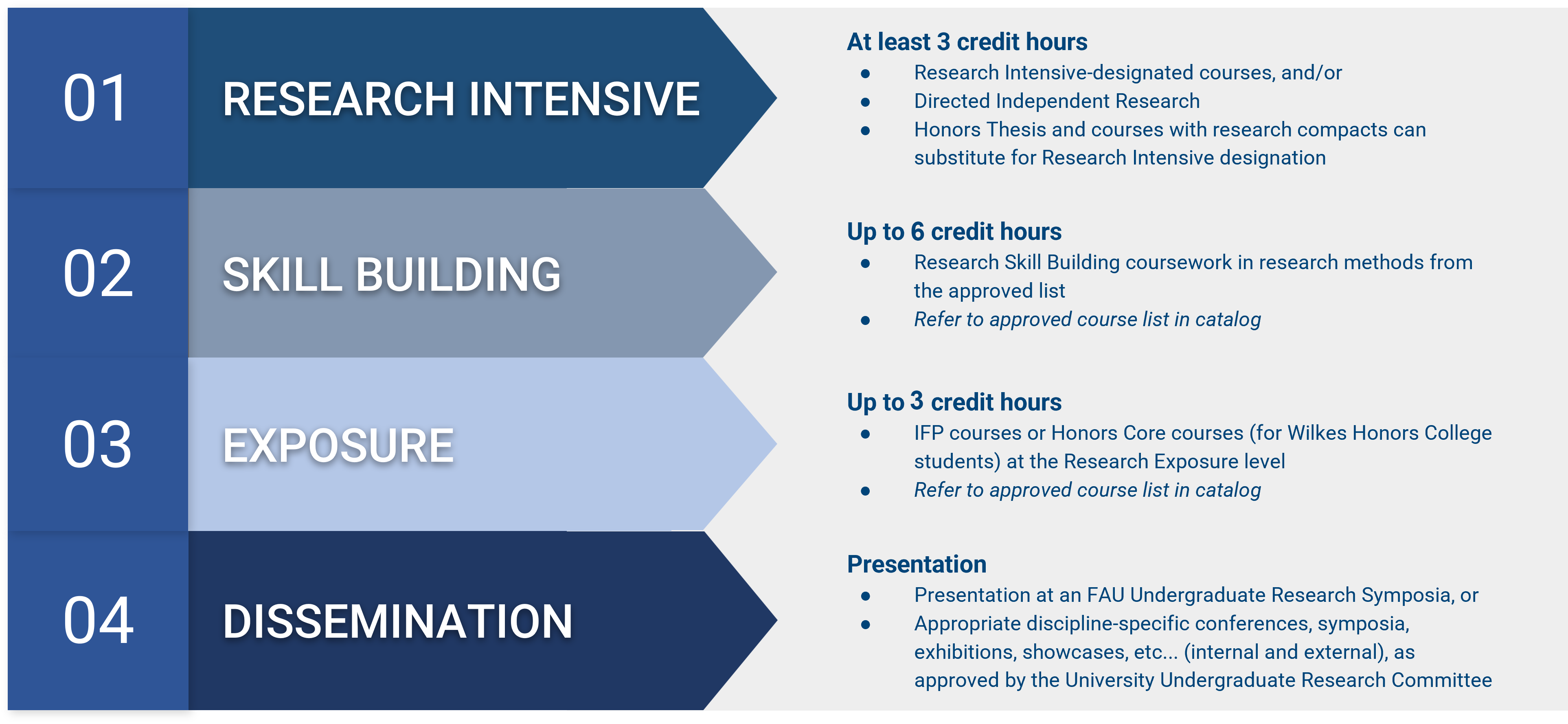
RI Designated Courses Skill Building Courses Exposure Courses
Additional Stipulations
-
Courses that are taken as S/U grading may count toward the Certificate with a grade of pass or satisfactory, but for courses with standard grading, students must complete coursework with a minimum of “C” or better
-
A maximum of 3 credits transferred can be applied to the Certificate
-
Course substitutions will be reviewed by the University Undergraduate Research Curriculum Committee on a case-by-case basis
How do I Apply for the Undergraduate Research Certificate?
OURI has created a stepwise instructions for students interested in declaring for the Undergraduate Research Certificate below:
Step-by-Step of Declaring the Undergraduate Research Certificate
OURI has created a stepwise instructions for Academic Advisor who are helping students declare the Undergraduate Research Certificate below:
Academic Advisor Frequently Asked Questions
Step-by-step for Wilkes Honors College Undergraduate students looking to declare the Undergraduate Research Certificate can be found below:
Step-by-Step Instructions for Wilkes Honors College Undergraduates
How Will I Know if I Satisfy the Criteria for the Certificate?
Please reach out to your academic advisor indicating your interest in pursuing the Undergraduate Research Certificate, so they can update your academic record. After your academic record has been updated to reflect your pursuit of the Undergraduate Research Certificate, you can run a DARS Audit: FAU - Degree Audit Reporting System (DARS)
For additional information students should consult with the Office of Undergraduate Research and Inquiry ouri@fau.edu, and/or their undergraduate advisors within the Colleges.